



Relief from Admissions

During discovery, each party may serve one or more sets of requests for admissions, asking the opposing side to admit that one or more facts are true or one or more documents are genuine. If a party admits a fact, or admits that a document is genuine, that fact, or the genuineness of the document in question, does not need to be proven at trial.
Occasionally, a party may inadvertently or mistakenly admit a fact that is not true, or may fail to respond to a request for admissions altogether, resulting in a court order deeming each of the facts listed in the request for admissions to be true, and each document listed in the request to be deemed genuine.
Templates and Forms
This Guide provides step-by-step instructions for asking to be relieved from these admissions, including a sample motion and a template that can be downloaded and modified to fit the facts and circumstances of your case.
Grounds for Relief
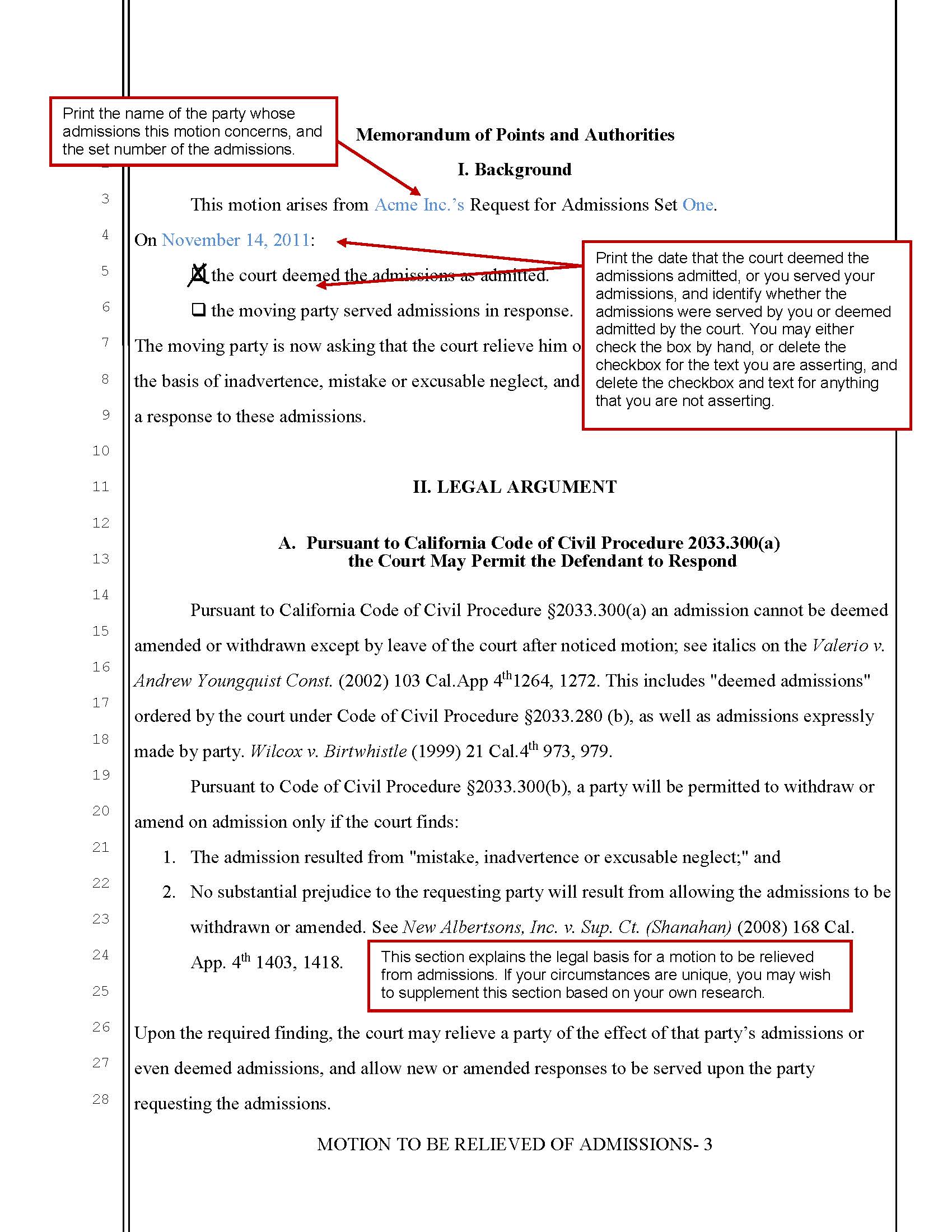
California Code of Civil Procedure (CCP) § 2033.300(b) allows a court to permit the withdrawal or amendment of admissions only if the court “determines that the admission was the result of mistake, inadvertence, or excusable neglect, and that the party who obtained the admission will not be substantially prejudiced in maintaining that party’s action or defense on the merits.”
Mistake, Inadvertence, or Excusable Neglect:
The party asking to be relieved from admissions must present sufficient evidence for the court to find that the admissions or failure to respond to the request for admissions was the result of a mistake, inadvertence, or excusable neglect. The act or omission that led to the admission must be one that a reasonably prudent person under the circumstances would make. Forgetting about the admissions, being too busy to properly respond, or being unable to afford an attorney are not sufficient grounds for relief. Some examples of reasons that might be excusable include:
- An unanticipated illness or injury that disabled the party, preventing him or her from responding;
- Reasonably, but mistakenly, believing that your former attorney had responded, based upon his or her representations;
- Having never received the request for admissions and subsequent motion to deem the admissions true, through no fault of your own;
- Misunderstanding a particularly complicated request, and incorrectly responding “admit” based upon this misunderstanding;
- Admitting or denying a fact based upon the information available at the time, only to determine through later-discovered evidence that your previous response was incorrect;
- Making a typographical error in the numbering of your responses such that your admissions do not correctly correspond to the requests, resulting in false statements being admitted, and true statements being denied.
Party Obtaining Admission Not Substantially Prejudiced in Maintaining Action:
After determining that an admission is the result of a mistake, inadvertence, or excusable neglect, the court must then consider whether the party that obtained the admission will be prejudiced if your motion to relieve the admission is granted. Some of the factors the court might find important in determining whether the other party will be prejudiced include, but are not limited, to:
- The promptness in which relief from admissions is granted;
- The nature of the facts that were admitted or deemed admitted;
- The reliance of the requesting party on the admission in conducting or not conducting further discovery.
In order to minimize any prejudice to the propounding or requesting party, the court may extend or reopen discovery, allow additional discovery, or make other orders to reduce any harm caused in granting your motion to be relieved from admissions.
As the party requesting to be relieved from the admissions, it is your burden to prove to the court both that the admission was the result of a mistake, inadvertence, or excusable neglect, and that the propounding party will not be prejudiced by the granting of your motion for relief from admissions.
Writing and Preparing the Motion
There is no Judicial Council form for this procedure. Instead, the relevant document must be typed on 28-line pleading paper. A customizable template may be downloaded from this link:
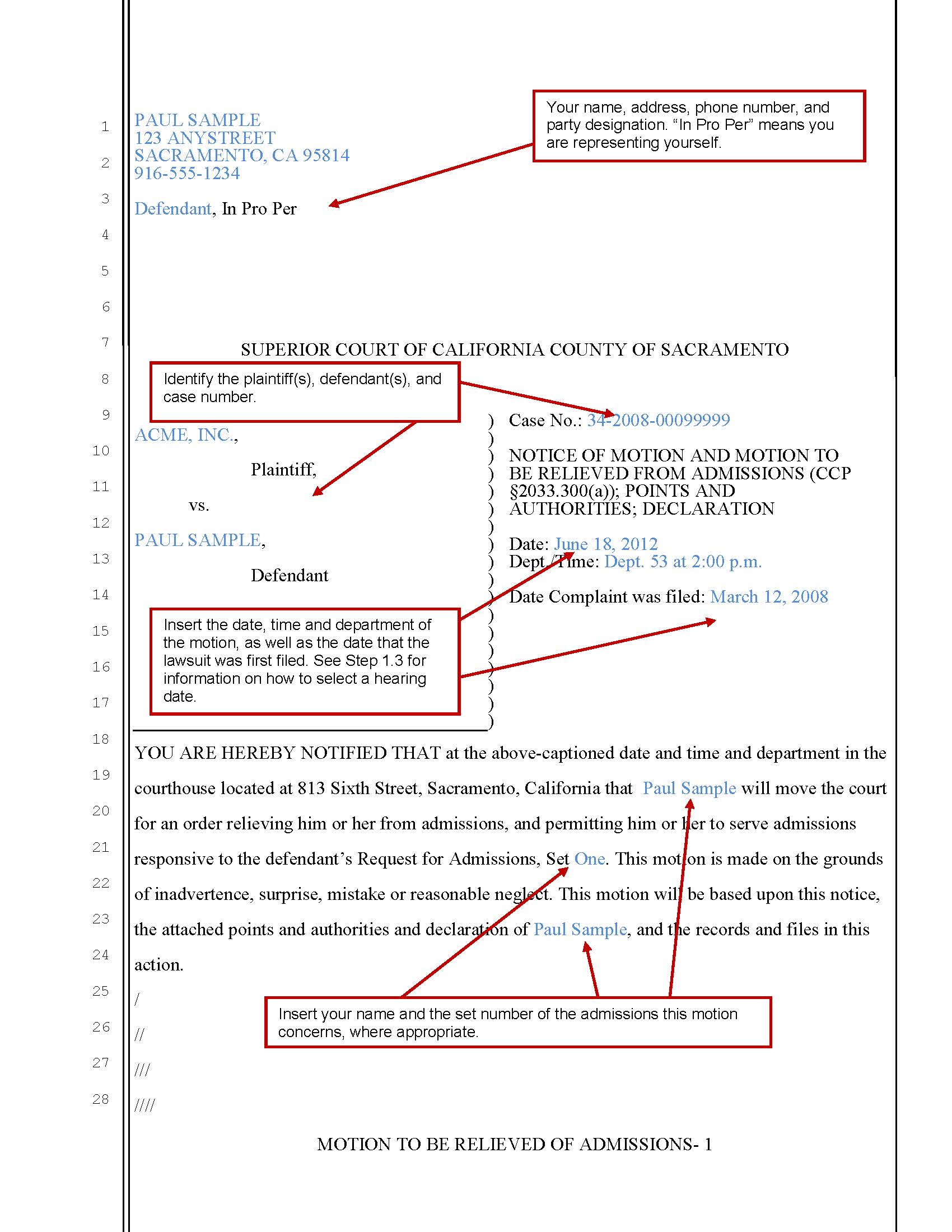
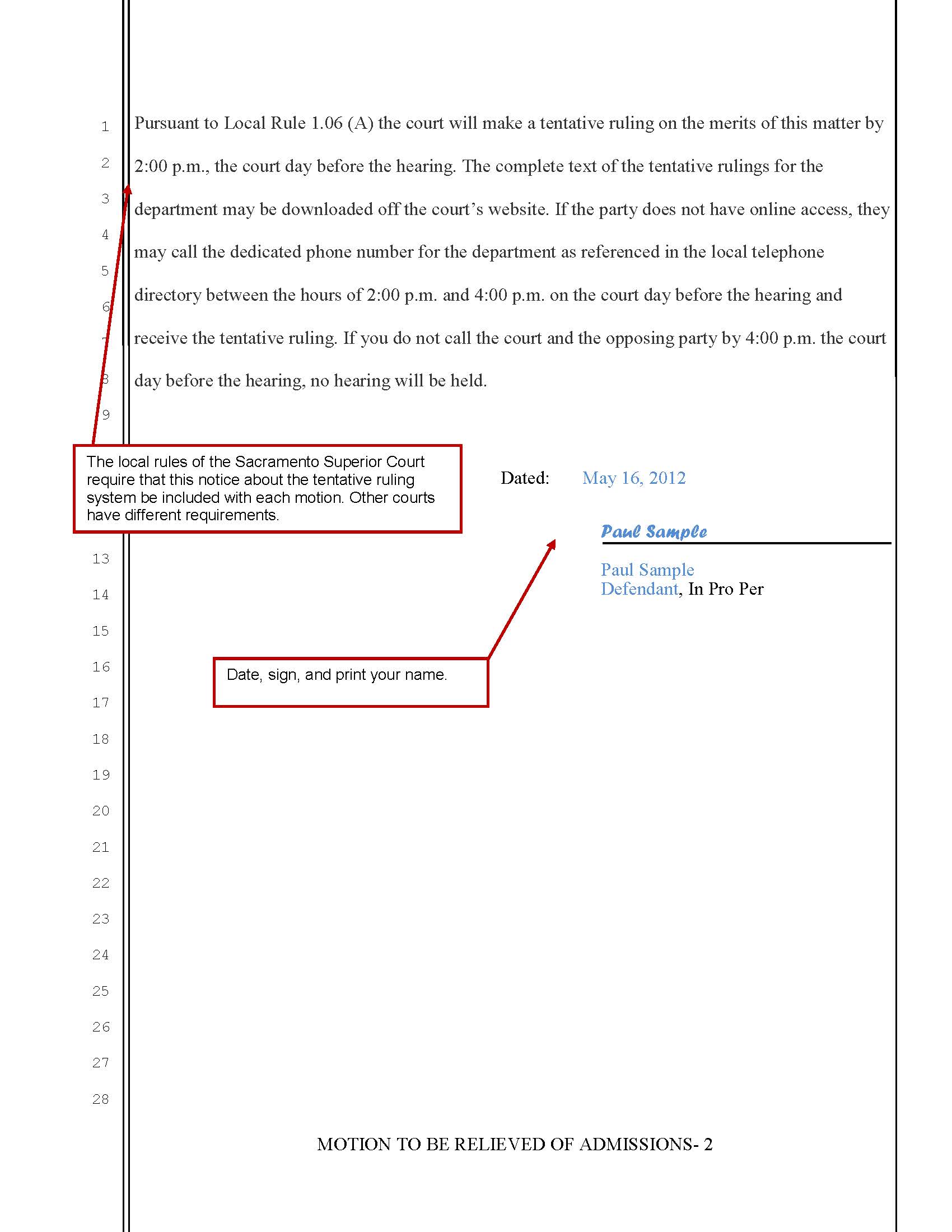
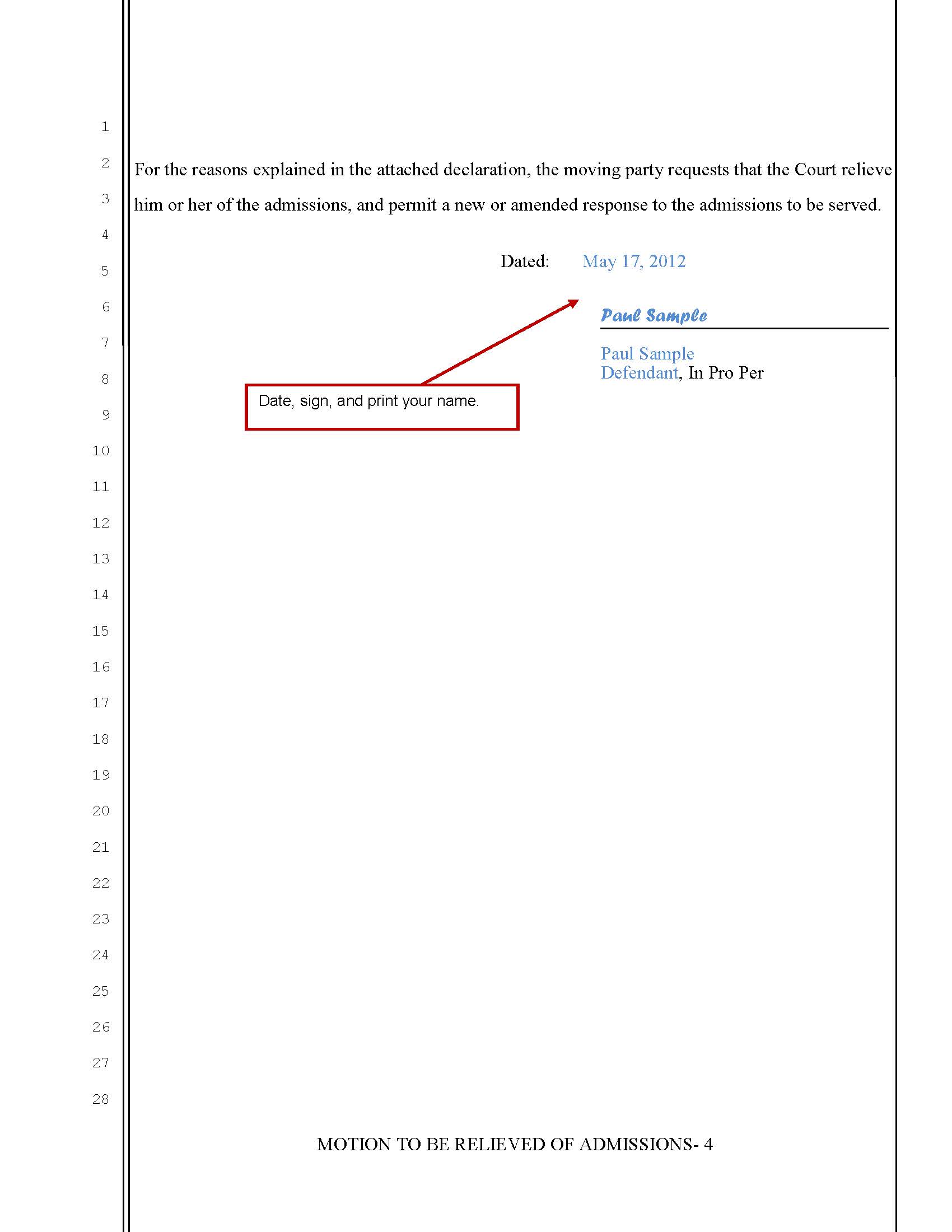
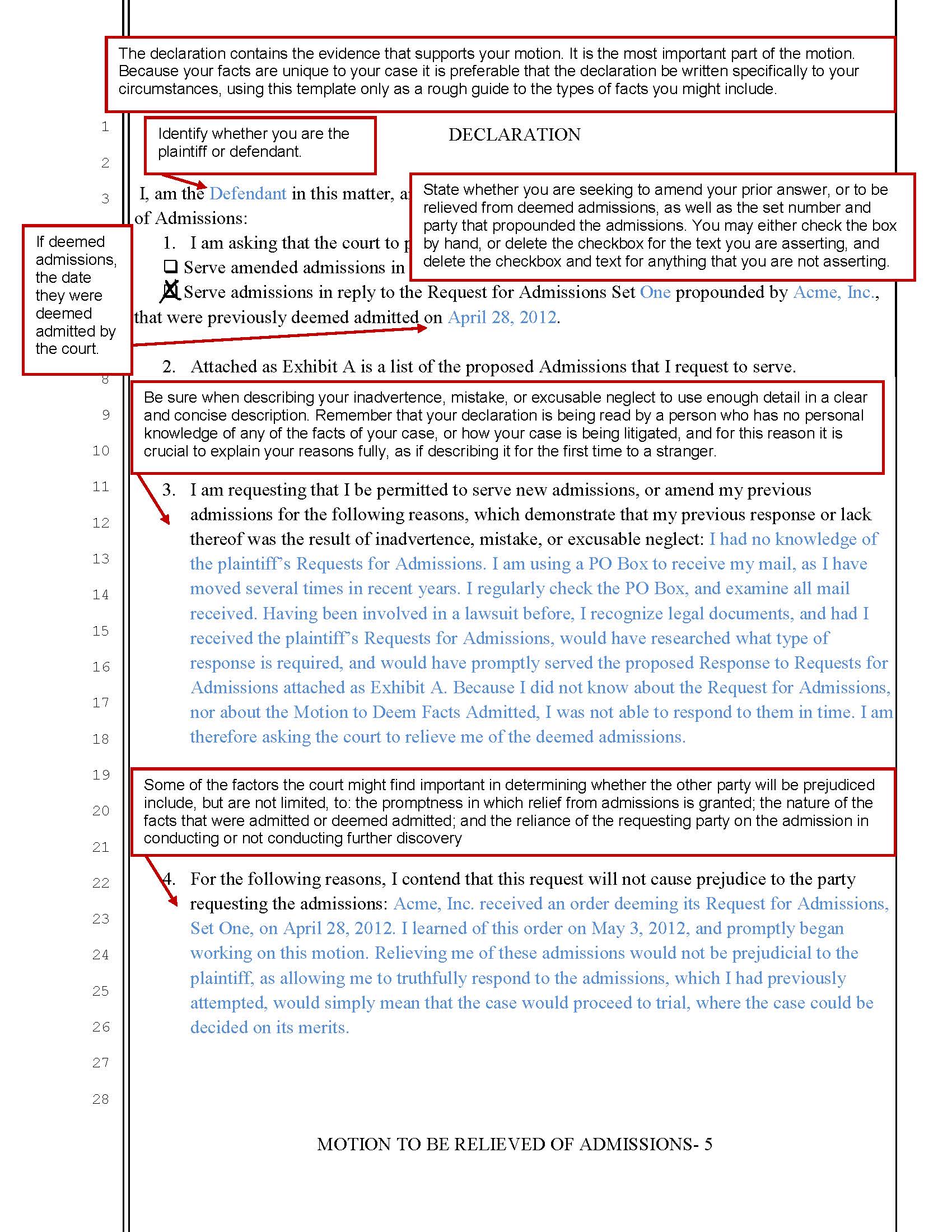
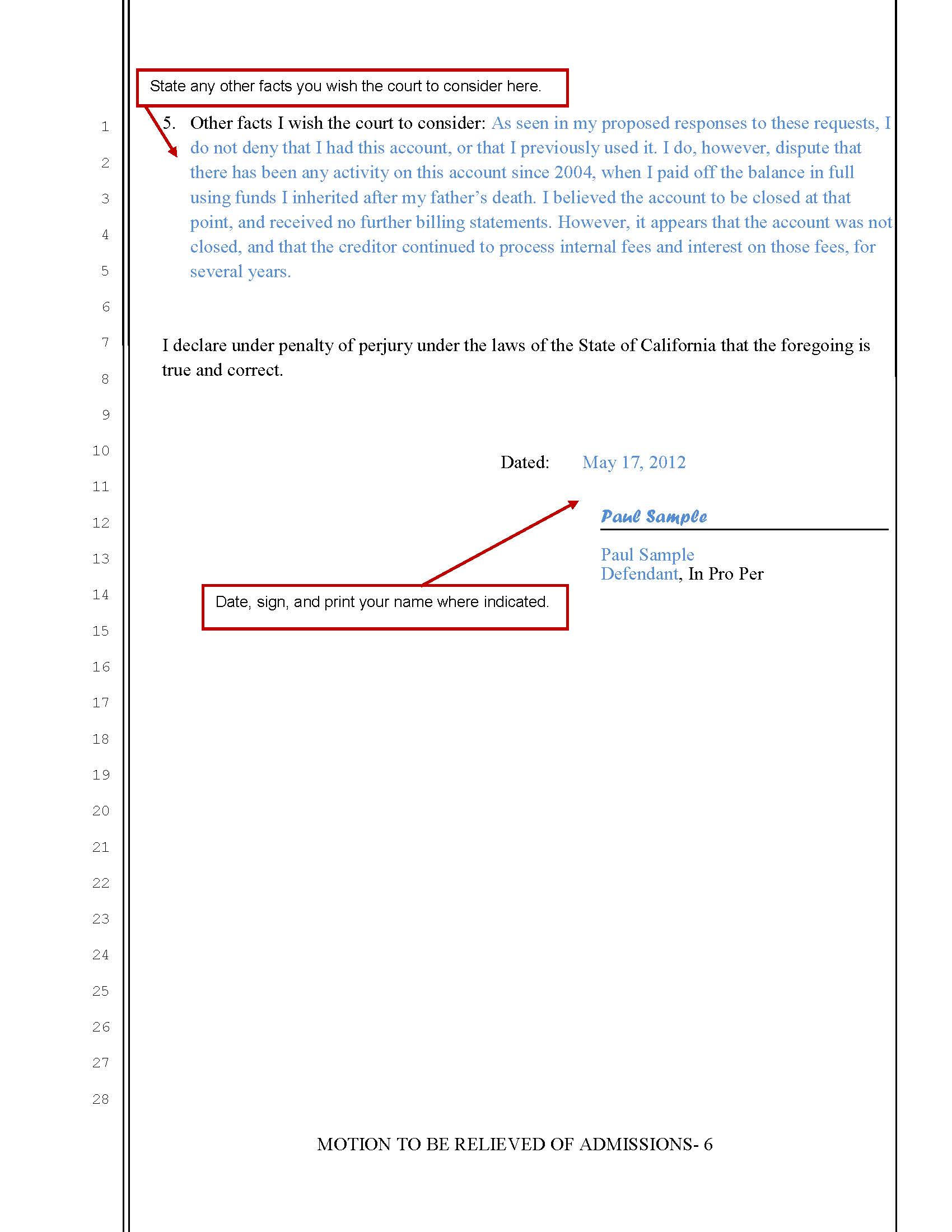
A filled-out sample is shown at the end of this guide.
Preparing a motion is not a quick or easy task. This guide attempts to break the process into manageable steps to help you file your motion successfully. For more details about writing and filing motions, see our guide Motions in Civil Cases.
Step-by-Step Instructions
1
Schedule the Hearing
This information is for Sacramento. If your case is in a different county, do not follow these instructions. Instead, call the clerk or visit the court website in your county to find the correct information.
Determine the department and time of the motion
In Sacramento, most motions are heard in the “Civil Home Court” department assigned to the case, which will be either department 8C, 8D, 16C, or 16D. Check your case file online to find which department your case is assigned to.
Effective April 13, 2026: Department 25 changed Department 8D; Department 28 changed to Department 8C; Department 53 changed to Department 16D; and Department 54 changed to Department 16C of the Tani G. Cantil-Sakauye Courthouse (500 G Street). If your case was filed before that date, its assigned department has changed, so check before scheduling a hearing.
More information about Civil Home Court department transition
A few types of motions are heard in other departments. Check which departments hear which types of motions in Sacramento on the Civil Motions webpage.
Reserve the date for the hearing
In the Civil Home Departments, for most motions, you must reserve a court date through the court’s online reservation system. (Exceptions are discovery-related motions to compel, which must be reserved in advance by calling the clerk of the assigned department.)
For other departments, contact the department clerk to determine the procedure.
To use the online system, go to the Sacramento Court Public Portal and choose “Reservation System (CRS).” You must have a free account on the system to use it.
Before you log on or call, figure out if there are any days you will not be available during the next couple of months. For instance, you don’t want to pick a date when you know you will be out of town.
You must choose a date far enough in the future that you can both file and serve your motion on time. Scheduling it four weeks in advance generally gives a comfortable margin for most types of motions. Usually, the first available date will be further away than that.
Determine the legal deadline to file the motion in court
Disclaimer! Some motions have different time requirements. Check the rules for the motion you are filing.
Tip: File the motion as soon as possible. Your reservation is not final until the motion has been filed and any fees paid.
The last legal day to file with the court is at least sixteen court (business) days prior to the motion date (CCP § 1005). “Court days” are Monday through Friday, excluding court holidays.
NOTE: the court must receive the documents by that day. Postmark will not count.
To determine whether a particular filing date will meet this deadline, start counting backwards on the day before your hearing until you reach the sixteenth court day. (CCP § 12c)
For example, suppose your reservation is for Monday, June 18. You would start counting backward using the previous court day, Friday, June 15, as day one, as shown in the calendar below. Skip weekends and court holidays (there is one court holiday in this example, which is Memorial Day, May 28). The sixteenth court day before the hearing would be May 24, which would be the last day that the motion could be filed.
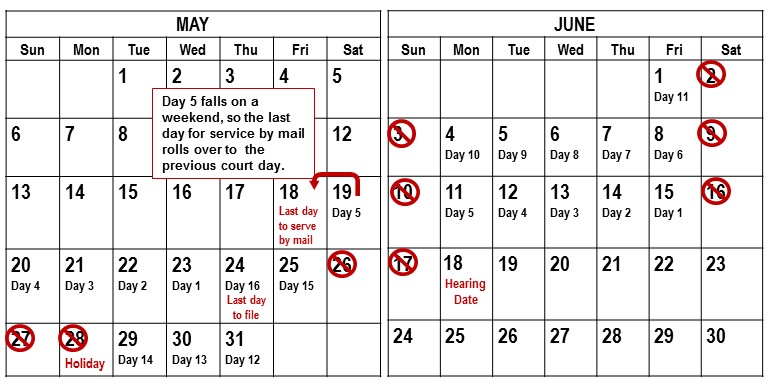
Make a note on your calendar to file the motion by this date. Do not miss this deadline. The court will cancel the hearing and you will have to start over.
Determine the legal deadline to serve the motion on the other parties or their attorneys
You must have a copy of the motion served on all other attorneys (or self-represented parties) by a strict deadline set by law. Earlier is always fine.
Personal service: 16 court days before the hearing, the same as the minimum filing deadline. The server should fill out Proof of Personal Service—Civil (POS-020).
Service by mail: 16 court days before hearing PLUS five calendar days before the hearing (more if the mailing address is outside California). (CCP § 1005). The server should fill out Proof of Service by First-Class Mail—Civil.
“Court days” are business days – Monday – Friday, except holidays.
“Calendar days” include weekends and holidays, but if the final day lands on a weekend or holiday, it is pushed back to the previous court day.
Make a note on your calendar to have the motion served by mail before the mail deadline. If you miss the mail deadline, you can still have the motion served by personal service up until 16 court days before the hearing. If you miss that deadline, you will have to cancel your court date and start over.
2
Research and write your declaration and memorandum
There is no pre-printed form for this motion. You will need to customize a motion on “pleading paper.” You can download a template from the link above. Instructions and a sample motion are at the end of this guide.
A request to deem an opposing party’s admissions true is made through a motion.
A motion is a request to the judge to issue an order of some sort. A written motion consists of four parts (the Notice of Motion and Motion are combined):
- Notice of Motion and Motion;
- Memorandum of Points and Authorities; and
- Declaration
These parts can be filed as separate documents or combined into one document, as in our template motion.
The Notice of Motion lets the opposing party know when and where the motion is scheduled to be heard, while the Motion lets the court and the opposing party know what is being requested. The Memorandum of Points and Authorities explains to the court and the opposing party the legal basis of the motion, while the Declaration provides evidence, sworn under penalty of perjury, supporting the motion.
The Declaration must contain the evidence you need to prove the facts you are asserting. Usually this will be by someone stating the facts under penalty of perjury. Often, it will also include photographs or documents that support your assertions. In most cases, the person making the motion will make the declaration. If someone else has personal knowledge of important facts, that person should also be asked for a declaration.
For tips and examples of how to write a declaration and what should be included, see our article “Declaration Tips.”
In some cases, you may need to file an additional document, such as a Request for Judicial Notice.
In your Memorandum, you must explain the facts of your situation, explain the law, and demonstrate how the law applies to those facts. This usually requires original research, analysis, and writing. At the end of this guide, you will find a list of reference books with good starting points for civil motion research
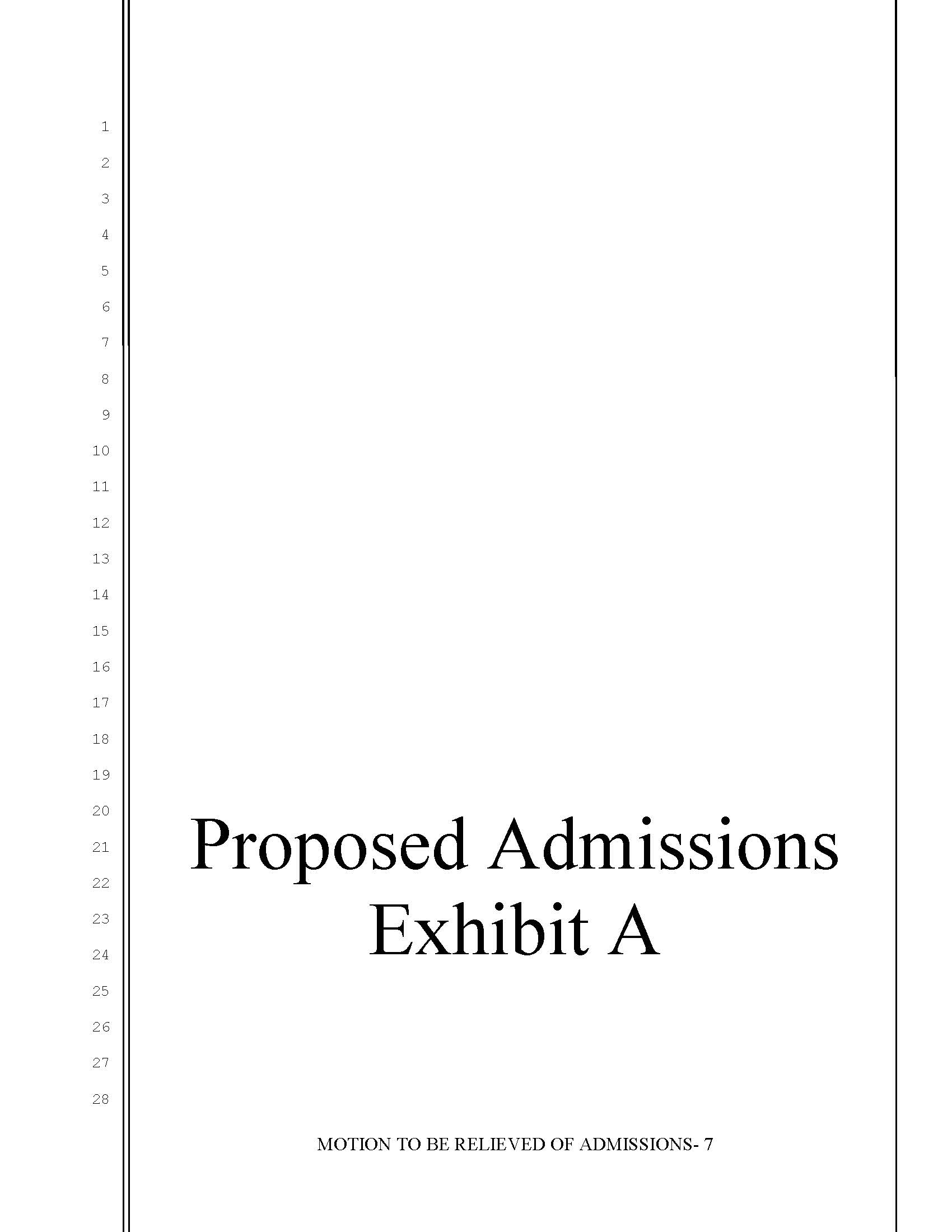
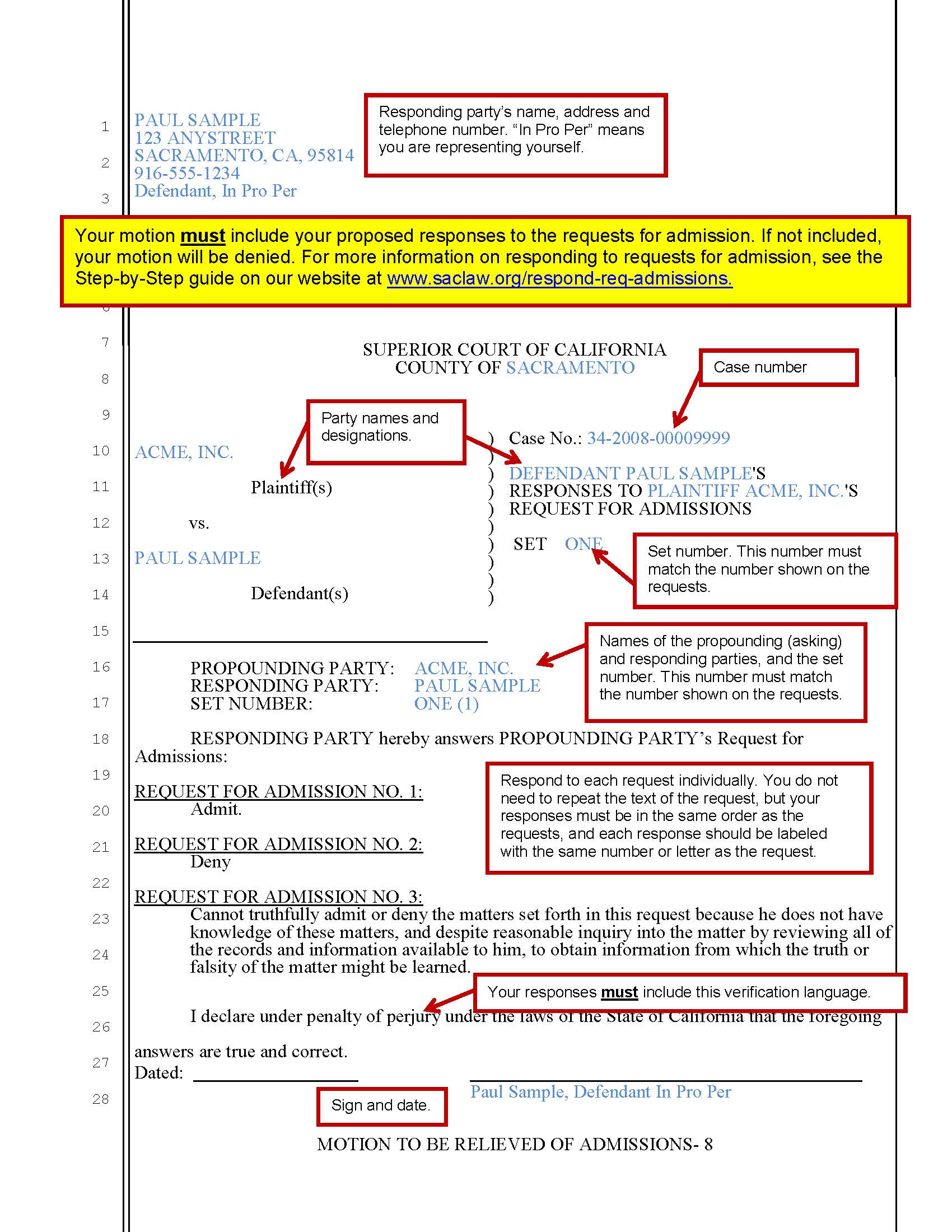
Include Proposed Responses in your Declaration: All Motions to be Relieved from Deemed Admissions must include a copy of the Proposed Responses to Request for Admissions. Because you have missed the original deadline, you are no longer allowed to raise any objections. For information about how to create your responses, see our guide Responding to Requests for Admission.
3
Assembling and copying papers for service
Put the motion and any other papers into proper order and format to serve the other side.
Before serving the documents, be sure that they include everything necessary, including the Notice of Motion and Motion, the Memorandum, supporting declaration(s) with exhibits attached, and any other documents such as request for judicial notice.
For each exhibit attached to your motion, you must place a page in front of the exhibit identifying it as Exhibit A, B, and so forth in alphabetical order, or Exhibit 1, 2, and so forth in numerical order. These are then attached at the end of your declaration.
Make enough copies of your papers to serve one set on each other party in the case, plus an optional one for you to keep. Staple the copies, but leave the original unstapled so it can easily be scanned into the court’s file system.
In a later step, you will either e-file the documents or file the original and your optional copy in the court.
4
Have Your Documents Served on the Attorney(s) or Self-Represented Party(s)
You must serve one copy on each other party in the case, and have the server sign the Proof of Service form.
You must have someone serve your papers on the other attorney or self-represented party in the case. (If there are more than two parties, you must serve all parties, or their attorneys if they have one).
Service must be complete 16 court (business) days before the hearing date, plus five calendar days if you have it served by mail.
Tip: If the mailing deadline (16+5 days) has passed, but there are still more than 16 court days before the hearing, you can have it served by personal delivery. If you miss the service deadline entirely, you will need to re-schedule your motion.
Proof of Service form:
After service is done, you will need to file a Proof of Service signed by the server. If serving by mail, you can use Proof of Service by Mail (POS-030). For personal service, use Proof of Personal Service (POS-020). You can fill most of the Proof of Service out now, but it should not be signed. Make a copy of the unsigned proof of service before proceeding and include it with the motion papers when you have them served.
After serving the papers, your server will sign the Proof of Service form, and give it to you.
Attach the original signed Proof of Service to your original signed motion. If you are using an optional copy for yourself, attach a copy of the Proof of Services to that.
You can also file it as a separate document, without attaching it to your motion papers.
5
Assemble your Documents for Filing
If you are e-filing, you will simply email the documents to the efiling provider of your choice.
Assemble your packet for filing as follows. The original should be unstapled, while any copy is stapled.
- Motion, including Memorandum of Points and Authorities and Declaration with exhibits: original plus one optional copy to be returned to you.
- Proposed Order, if included, plus one optional copy.
- Completed Proof of Service form: The original plus plus one optional copy. This proof of service can filed as its own document, or it can be attached as the last page of the Motion when filing. If it is attached, then attach the original signed Proof of Service to the original signed Motion.
- Any other documents, such as Request for Judicial Notice, should be treated the same way: create a stack of original plus one optional copy and file along with the others.
If you are submitting the papers in the dropbox, you will find cover sheets and large binder clips to hold the whole package together near the box.
6
File Your Motion Papers by the Deadline
As long as your filing is received by the deadline (16 court days before the hearing), you can file at the counter, by dropbox, or by mail. But note that it must be received by the deadline. Postmarked does not count.
As of April 13, 2026, all civil moving papers, oppositions, and replies can be e-Filed, mailed to the Tani G. Cantil-Sakauye Courthouse, 500 G St., 2nd Fl., Sacramento, CA 95814, or filed in person.
Your options are:
- Wait in line to file with the clerk in the Filing Room (second floor).
- Drop your paperwork and payment in the dropbox on the second floor. Payment must be by check or money order. Your papers will be marked as filed on the day you place them in the box if they arrive before 5 p.m.
- Mail your paperwork and payment to: to the Tani G. Cantil-Sakauye Courthouse, 500 G St., 2nd Fl., Sacramento, CA 95814. Payment must be by check or money order. Your papers must arrive by the due date; the postmark will be ignored.
- Use the court’s efiling system. This system is optional for self-represented litigants. Fees will be paid to the electronic filing service provider, which forwards them to the court.
At this time there is a $60 filing fee for a motion, unless your fees were waived. Dropbox filings must include a check or money order/cashiers check, no credit cards. Credit cards can be accepted at the counter or used when efiling.
Fee Waiver: If you are receiving government benefits such as Medi-Cal or are otherwise qualified because of low income, you can apply for a fee waiver. If you do not yet have a fee waiver, turn the fee waiver request forms in with the motion instead of a fee payment. For more information, see our Step-by-Step guide on Fee Waivers.
7
Opposition Papers and the Moving Party’s Optional Reply Papers
The opposing party must file written opposition or risk losing automatically. The moving party may file and serve a Reply, but it is optional.
If any opposing counsel or self-represented party opposes the motion, they may serve and file an opposition at least nine court days prior to the hearing. No fee is required to file an opposition.
Written Opposition is required. Going to the hearing is not sufficient. If you do not file a written Opposition on time, the judge will probably grant the Motion and cancel the hearing.
The opposition contains a memorandum of points and authorities and usually a declaration, but does not need the notice of motion or motion. Be sure to check your mail, and read any documents you receive carefully.
The moving party may choose to serve and file a reply to the opposition at least five court days prior to the motion. CCP § 1005. It must be served by overnight mail to reach the opposing party no more than one day after it is filed.
The reply is optional and is usually used to address new issues the opponent raised in the opposition. No fee is required to file a reply. See our guide on Writing, Scheduling, and Opposing Motions for more information.
8
Review Tentative Ruling at 2 p.m. the Court Day before the Hearing; Schedule Argument by 4 p.m. if Necessary
Before the hearing, the judge reads the papers and decides how they plan to rule. They post the decision on the court’s website the day before the hearing. If a party wants a chance to speak to the judge to change their mind, they must notify the other party and the court by 4 p.m.
Most California courts use the tentative ruling system. In Sacramento, pursuant to Local Rule 1.06, the Civil Home Court departments issue tentative rulings on the motion by 2:00 p.m. the court day before the hearing. You then have two hours to request oral argument, if you choose to do so. Other departments may have different times or may not use tentative rulings; check with the department clerk.
Warning!
Your hearing will be canceled
If neither party calls the court, the hearing will be canceled and you will not be permitted to talk to the judge.
You may read the tentative ruling online or call 916-874-7858 or 916-874-7848 to have a clerk read the ruling to you. For more information, see the Sacramento County Superior Court’s Civil Tentative Rulings page.
Closely review the Tentative Ruling. If you are making the motion, you are looking for your motion to be “GRANTED.” If you are opposing the motion, you are looking for the motion to be “DENIED.” The motion may also be “GRANTED IN PART” and “DENIED IN PART.” The judge sometimes orders the parties to appear (“APPEARANCE REQUIRED”), even if neither party requests oral argument.
Losing party: If you are not happy with the Tentative Ruling, and wish to present oral argument in front of the judge, you must call all opposing counsel and/or self-represented parties right away. Let them know that that you are appearing, and that they can appear via Zoom. Leaving a message is fine.
Then call the Law and Motion Oral Argument Request Line at (916) 874-2615 before 4:00 p.m. Leave a message with the following information: 1. Your name, and that you want to appear; 2. the item number (to the left of your case number on the Tentative Ruling); and 3. that you have let the other parties know you are appearing, and that they can appear via Zoom.
Note: carefully consider whether it is worth your time to request oral argument. It is very rare for judges to change their mind, but it does happen sometimes.
Winning party: If you are happy with the Tentative Ruling, you do not need to do anything unless the Tentative Ruling orders you to appear, or the other side calls you before 4:00 p.m. that day to request oral argument. If that happens, you should go to the court hearing in person or by Zoom and be prepared to argue your case.
If neither party requests oral argument by 4:00 p.m., the court will simply make the tentative ruling permanent, and no oral argument will be permitted.
9
Attend the Hearing, if Required
If neither party calls the court and opposing party to request oral argument, the hearing will be cancelled, and the tentative ruling will become final.
If you or the other party request oral argument, arrive in court or log onto Zoom early. There will probably be other cases scheduled at the same time; there is usually a list posted on the wall outside the courtroom that lists the order in which cases will be heard. Go into the courtroom or Zoom waiting room and check in with the bailiff or clerk.
In Person
As of April 13, all Law and Motion hearings will take place at 500 G St., Sacramento (the new Railyard area courthouse).
When your name is called, be ready to speak and to answer any questions the judge has. You will only have a few minutes. After both sides speak, the judge may make a decision right away, or may “take it under consideration” and mail out the decision in a few days.
If you have questions about the order, you can ask them at the hearing. Make sure you understand if you are expected to do something as a result of the order. For instance, if you are ordered to file an amended complaint or serve responses, make sure you know the deadline and what is expected.
For Help
SH@LL (Self-Help at the Law Library)
609 9th Street, Sacramento CA 95814
(916) 476-2731 (Appointment Request Line)
Services Provided: SH@LL provides general information and basic assistance to self-represented litigants on a variety of legal issues. All assistance is provided by telephone. Visit “What we can help with” for a list of qualifying cases.
Eligibility: Must be a Sacramento County resident or have a qualifying case in the Sacramento County Superior Court.
For More Information
Introduction to Discovery – Part 3: Response to Request for Admissions
This video was created by Sacramento County Public Law Library’s Civil Self Help Center to assist self-represented litigants in responding to requests for admissions, and may be helpful to prepare your proposed responses.
California Civil Discovery Practice KFC 1020 .C35
Electronic Access: On the Law Library computers, using OnLaw.
California Practice Guide: Civil Procedure Before Trial KFC 995 .W45
California Forms of Pleading and Practice KFC 1010 .A65 C3 (Ready Reference)
Electronic Access: On the Law Library computers, using Lexis Advance.
California Civil Practice: Procedure KFC 995 .A65 B3
California Points and Authorities KFC 1010 .B4 (Ready Reference)
Electronic Access: On the Law Library computers, using Lexis Advance.
Sample
This material is intended as general information only. Your case may have factors requiring different procedures or forms. The information and instructions are provided for use in the Sacramento County Superior Court. Please keep in mind that each court may have different requirements. If you need further assistance consult a lawyer.