



Appealing CUIAB Denial of Unemployment Benefits to the Superior Court

Use a writ of administrative mandate (mandamus) to appeal
If you have been denied unemployment benefits, and have exhausted all of your administrative appeals, you may petition the court to review the denial of benefits by seeking a writ of administrative mandate (or mandamus), pursuant to California Code of Civil Procedure (CCP) § 1094.5.
Templates and Forms
A petition for writ of administrative mandate is a request to have the court review the agency’s decision, and to issue a writ directing the agency to set aside its decision, reconsider its decision, or take some other type of action. You may not file this type of petition until you exhaust all administrative remedies.
To exhaust your administrative remedies in your unemployment insurance benefit case, you must have completed all of the following administrative steps:
- Filed for unemployment insurance benefits with the Employment Development Department (EDD)
- Been denied benefits by EDD
- Appealed the EDD’s decision within the limits stated on the denial letter (20 days)
- Attended a hearing before an administrative law judge (ALJ) to appeal the decision, and had the appeal denied by the ALJ
- Appealed the denial by the ALJ to the California Unemployment Insurance Appeals Board (Board) within the time limit specified on the decision (20 days)
- Had your final appeal denied by the Board.
You have only six months to file your Petition for Writ of Administrative Mandate from the date the California Unemployment Insurance Appeals Board mails you the notice of denial of the final appeal.
Your petition for a writ of mandate is not a new hearing or trial on the matter. Instead, the court reviews the administrative proceedings to ensure that the agency proceeded in accordance with the law, that you received a fair trial, and that there was not prejudicial abuse of discretion. Prejudicial abuse of discretion can mean that the agency did not follow the proper procedures, or that the agency’s decision is not supported by the evidence and findings. In most cases, the court must rely only on the evidence that was previously presented during the administrative hearing.
In its review, the court looks at decisions of law “de novo,” meaning that the court will make its own decision whether the correct laws were applied, whether they were applied correctly to the facts of the case, and whether proper procedure was followed.
The court will typically accept the factual findings of the administrative judge, unless the findings are not supported by substantial evidence. The judge hearing your writ of mandate request was not at the prior hearings to see the evidence that was presented, so they will presume that the ALJ who did see the evidence is better informed when deciding the facts of the case. For this reason, when challenging factual findings, the court will determine only whether an ALJ could have reasonably come to their factual conclusion based on the evidence that was presented.
Step-by-Step Instructions
1
Review the Decisions
Carefully review all decisions previously issued in your case. Since you are seeking to overturn these decisions, you will want to read them carefully to understand the reasons stated for the denial. You should ideally research the law as it relates to each basis stated for the denial, so that you may make an informed decision whether or not to seek a writ of mandate.
2
Complete the Pleadings
There is no standard Judicial Council form for the Petition for Writ of Mandate. Instead, the relevant documents must be typed on 28-line pleading paper. Customizable templates may be downloaded from these links:
At the end of this Guide is a sample Petition for Writ of Mandate and a sample Notice of Hearing for Writ of Mandate. Use these as models to draft your own versions.
You will also need:
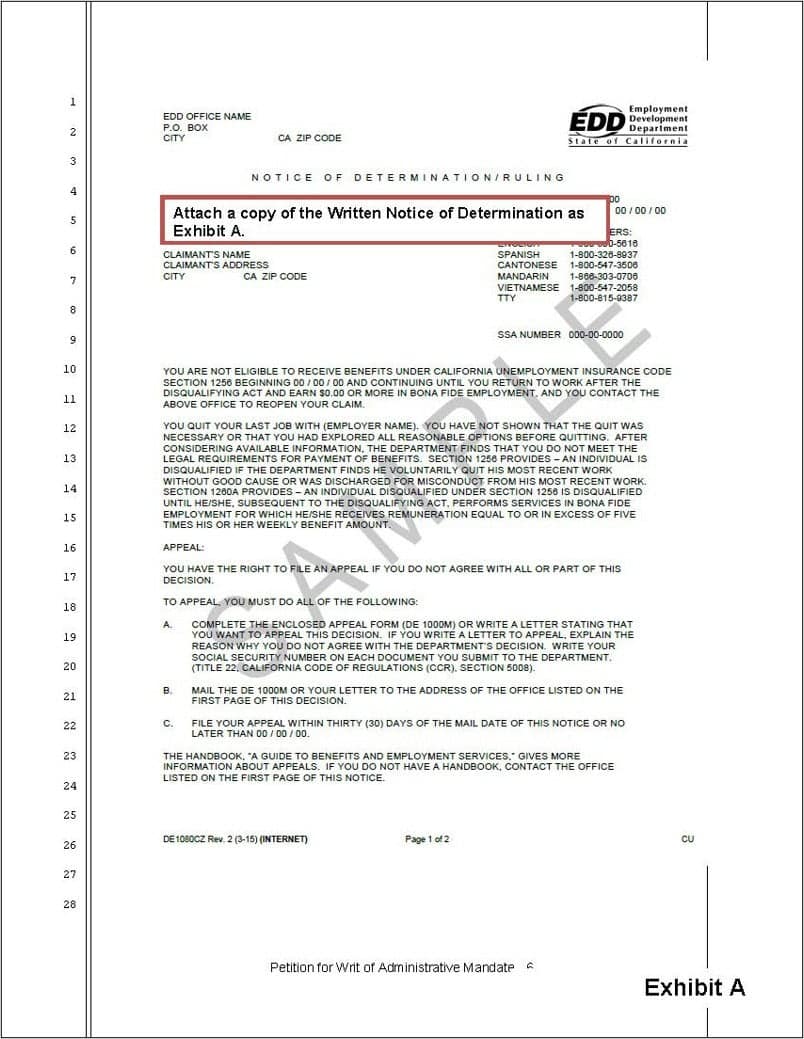
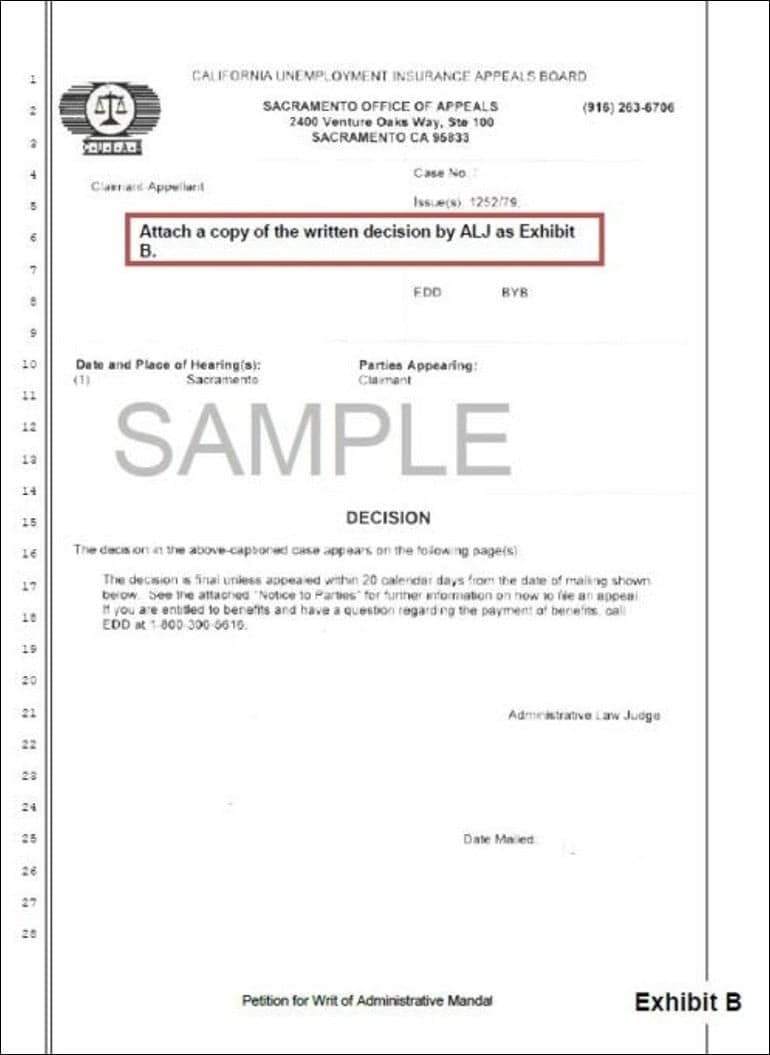
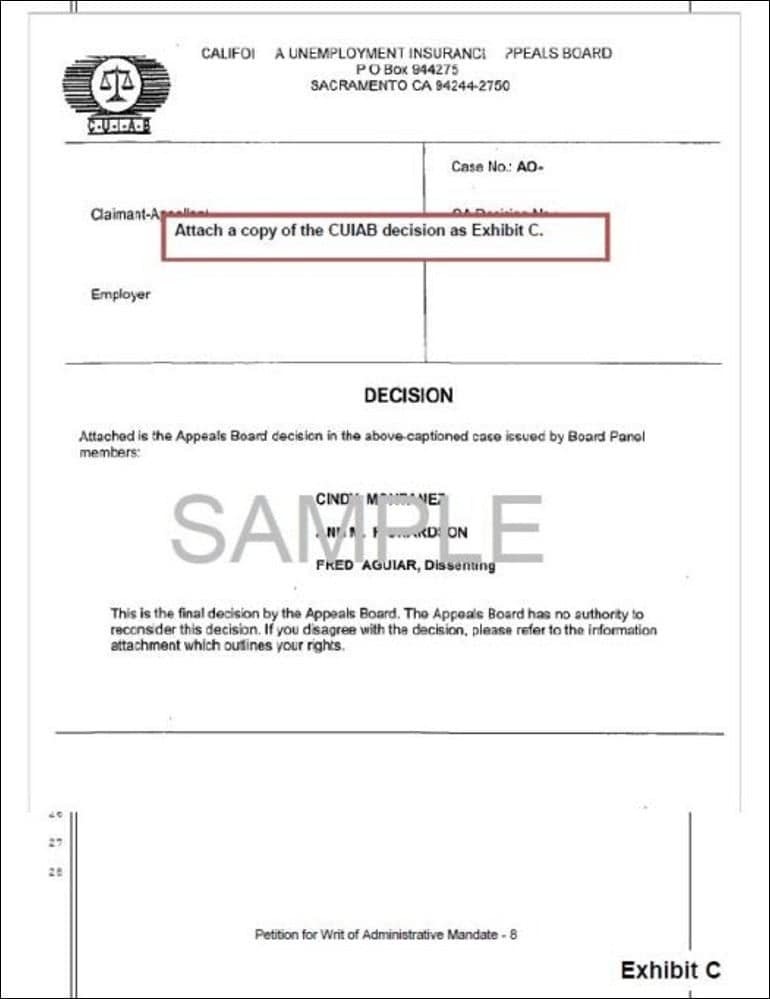
Exhibits: You will need to attach a copy of each prior decision in your case to the Petition. Attach the EDD’s written Notice of Determination as Exhibit A, the ALJ’s written decision as Exhibit B, and the CUIAB’s decision affirming or reversing the ALJ as Exhibit C. Photocopy each decision and write its exhibit letter on the bottom of the first page. If an exhibit is longer than one page, number each page A‑1, A‑2, A‑3, and so forth.
3
Make Copies
Make two photocopies of each:
- Civil Case Cover Sheet (CM-010)
- Petition for Writ of Mandate (including the exhibits)
Staple each of the copies, but leave the original unstapled so it can easily be scanned into the court’s file system. If you choose, you can also make an additional copy for the court to return to you, but you will be able to download it from the court’s online portal at no charge.
4
File Your Documents
File your documents at the Gordon D. Schaber Courthouse at 720 Ninth Street in downtown Sacramento.
File the original and two copies of the petition and a civil case cover sheet at the civil
front counter in Room 102 on the first floor of the main courthouse. Or mail an original and two copies of the petition and a civil case cover sheet to the Civil Division – Room 102, 720 9th Street, Sacramento, CA 95814.
The filing fee was $435 at the time of this update. Current fees are available on the Sacramento County Superior Court’s website (Fee Schedule). You may qualify for a fee waiver. If if so, you may file a request with the court. For more information, see the Step-by-Step Guide on Fee Waivers on our website at Fee Waivers.
When you file, the clerk will issue a case number and assign a department for your Petition. The court will keep the original of each document, but will return the photocopies to you. In addition, the clerk will give you a number of informational documents, including a “Guide to the Procedures for Prosecuting Petitions for Prerogative Writs.”
5
Have Your Documents Served
Someone over the age of eighteen who is not you, or any other party in your case, must personally the California Unemployment Insurance Appeals Board and the employer (“real party in interest” in the case), or the employer’s attorney, if represented. Your server must deliver these documents:
- Civil Case Cover Sheet
- Petition for Writ of Mandate (with exhibits)
- Notice of Case Assignment (provided by the court when you file);
- “Guide to Procedures for Prosecuting Petitions for Prerogative Writs” (provided by the court when you file).
The person who is serving your documents must complete a proof of service form, Proof of Personal Service (POS-020). For more information about Proofs of Personal Service, see the Guide on our website at Personal Service.
Once the other parties have been served, file the original and two photocopies of the completed and signed Proof of Personal Service form(s) with the court. The court cannot issue any orders in the case until all responding parties have been timely served.
Important Note: Each of the four departments that handles writs has some additional requirements for Steps 6,7, and 8. For instance, Department 12 prefers emails instead of phone calls; Department 21 prefers in-person appearances and requires permission to appear remotely. Carefully read the section of the Prerogative Writ Departments and Protocol relating to your assigned department.
6
Request and Lodge the Administrative Record with the Court
Request in writing to the California Unemployment Insurance Appeals Board that a copy of the administrative record be sent to the Superior Court, and request a copy for yourself as well. The court will require an electronic version, so ask for it on a flash drive, CD, or DVD.. The petitioner (you) bears the cost of this duplication.
The administrative record will contain all of the documents and orders filed in your Unemployment Insurance appeal. If your proceedings were officially recorded or had a court reporter, you may want request that a transcript of the hearing be created and lodge with the court if your argument depends in any way on what was said during your hearing.
The administrative record must be lodged directly in the assigned department (not in Room 102, where you file most things) at least 25 days prior to your hearing. Consult the rules for your assigned department, as details may differ. (Prerogative Writ Departments and Protocol).
7
Set the Date for the Hearing and Give Other Parties Notice
Each county will have different procedures. In Sacramento, to obtain a hearing date for your writ:
- Check the days and times when your assigned department holds hearings. Most departments hold hearings on Fridays, but that can change at any time. Get the current information online at Prerogative Writ Departments and Protocol.
- At this time, inform the clerk how many pages the administrative record will be.
- Contact all opposing counsel (or self-represented parties) to determine a list of dates you would each find acceptable. Be sure that the date allows you to comply with the briefing schedule described in Step 8.
- Contact the writ department assigned to your case in step 4 to reserve the agreed-upon date.
- Prepare the Notice of Hearing for Writ of Mandate, a template for which may be downloaded from the link in Step 2.
- Have the other parties (or their attorneys if they are represented) served with the Notice of Hearing. Any party that has filed any documents with the Superior Court in the case may be served by mail, while any parties who have not filed any documents (“appeared”) in this case must be personally served.
- File the Notice of Hearing and Proof(s) of Service with the court.
For more information about Proof of Service by Mail, see the Guide on our website at Serving Documents by Mail.
8
Serve and File Yout Opening Brief
Since the burden is on the petitioner (you) to establish the legal grounds upon which you base your writ of mandate, you must serve and file an opening brief. The opposition would then serve and file an opposing brief. In response, you may then file a reply brief.
Briefing Schedule
Although the opening brief may be filed at the time you set the date for the hearing on the Writ, you must be careful to leave enough time prior to the hearing for the following deadlines to be met:
- The opening brief must be served and filed at least 45 days before the hearing;
- The opposition brief must be filed at least 25 days before the hearing; and
- A reply brief (responding to the opposition) may be filed at least 15 days before the hearing.
Because the legal issues in each brief are unique to a particular case, it is not feasible to include a sample brief with this Guide. Pursuant to Sacramento Superior Court Local Rule 2.26(D), the opening and opposition briefs are limited to 30 pages, while the reply brief is limited to 20 pages. The purpose of your brief is to make your legal argument in favor of granting your request. As such, an opening brief should include an introduction, a summary of the procedural history of the case, and a legal argument in favor of your request for each of the mistakes you allege that the trial court made.
9
Check Tentative Rulings
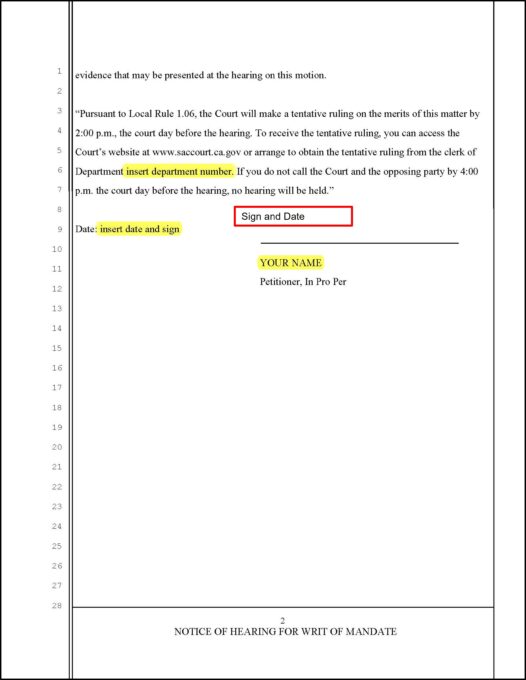
Pursuant to Sacramento Superior Court Local Rule 1.06, the court will make a tentative ruling on the merits of your writ by 2:00 p.m. the court day before the hearing. You may read the tentative ruling online, or you may call the clerk for the department assigned to your writ to have them read it to you. For more information, see the Sacramento County Superior Court’s website at Prerogative Writ Departments and Protocol.
Review the tentative ruling very carefully. If you are not happy with the tentative ruling, and wish to present arguments in front of the judge, you must call all opposing counsel (or self-represented parties), as well as the clerk for the department assigned to your writ, no later than 4:00 p.m. the court day before your hearing and state that you are requesting oral argument.
If neither you nor the opposing counsel or self-represented party requests oral argument, the court will simply make the tentative ruling the order of the court, and no oral argument will be permitted.
10
Attend the Hearing
If you or the opposing counsel or self-represented party request oral argument, be sure to attend the hearing. Assuming that both the administrative record and the opening brief have been lodged with the court in a timely manner, the court will consider the merits of your request at the hearing.
The judge has a great deal of discretion as to how he or she wishes to conduct the hearing. The burden is on you, the petitioner, to convince the court to grant your petition, so typically the petitioner will be permitted to present first. Keep in mind that the judge has likely read the briefs of all parties, so it is important to listen carefully to any guidance the judge might provide as to whether he or she wants the entire matter argued, or only wishes oral argument on specific points.
11
Prepare Your Judgment and Writ
If you win your petition, you will be directed to create a formal judgment granting your writ, as well as the writ of of mandate itself. The judgment should mirror the language that the court used in the minute order, while the writ should mirror the relevant language in the judgment. When creating signature lines, please note that the judgment is signed by the judge, while the writ is signed by a deputy clerk.
Samples of the format for each are available in California Administrative Mandamus, at sections 15.39 and 15.41, respectively.
For help
Legal Aid at Work
Assistance to low-income Californians on work-related legal issues. Areas of assistance include wage theft, race discrimination, sexual harassment, retaliation based on immigration status, unemployment insurance, paid family leave, and workers’ compensation.
Website: Legal Aid at Work
180 Montgomery Street, San Francisco, CA 94104
(916) 905-5857
Capital Pro Bono Employment Law Clinic
Advice and assistance with wrongful termination, recovering unpaid wages, Unemployment Insurance appeals, and resolving harassment or discrimination in the workplace. Call 916-551-2167 or fill out their online Contact Us form.
Website: Capital Pro Bono
1321 Howe Avenue
Sacramento, CA 95825
916-551-2167
Legal Services of Northern California (LSNC)
Provides a broad range of civil legal services to residents of Sacramento County who fall below federal poverty guidelines, including help with benefits programs.
Website: Legal Services of Northern California
515 12th Street
Sacramento, CA 95814
916-551-2150
For more information
At the Law Library
California Administrative Mandamus KFC782 .C34
Electronic Access: On the Law Library’s computers, using OnLaw.
California Practice Guide: Administrative Law KFC780 .A975
Volume 2
On the web
California Unemployment Appeals Insurance Board, Filing an Appeal
San Mateo County Law Library, Research Guide 13: Writ of Administrative Mandate (Mandamus)
Provides overview and additional sample templates.
Samples
Petition for Writ of Mandate
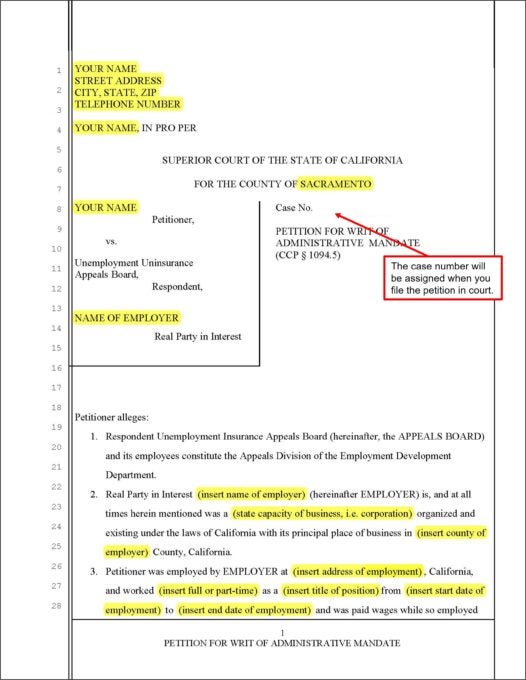
.
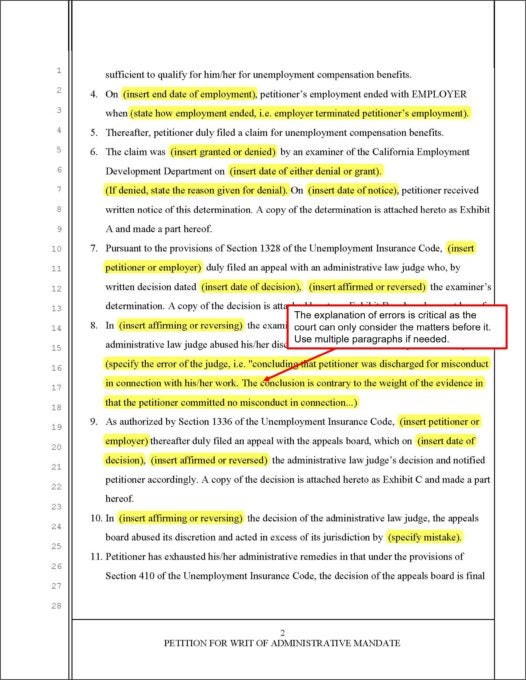
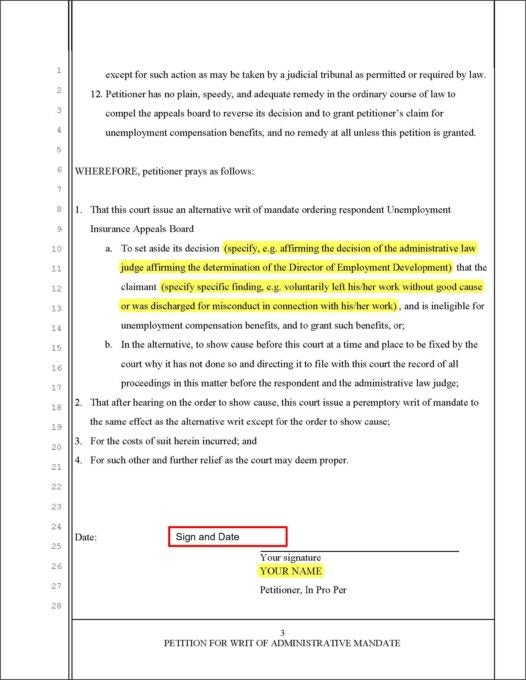
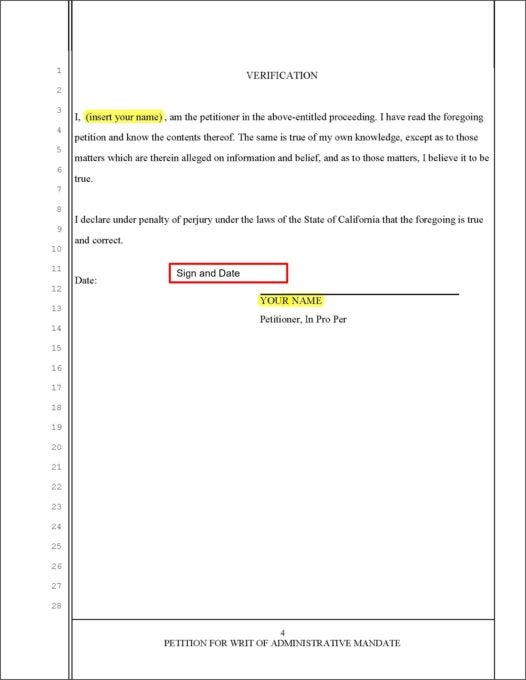
Notice of Hearing for Writ of Mandate

This material is intended as general information only. Your case may have factors requiring different procedures or forms. The information and instructions are provided for use in the Sacramento County Superior Court. Please keep in mind that each court may have different requirements. If you need further assistance consult a lawyer.